
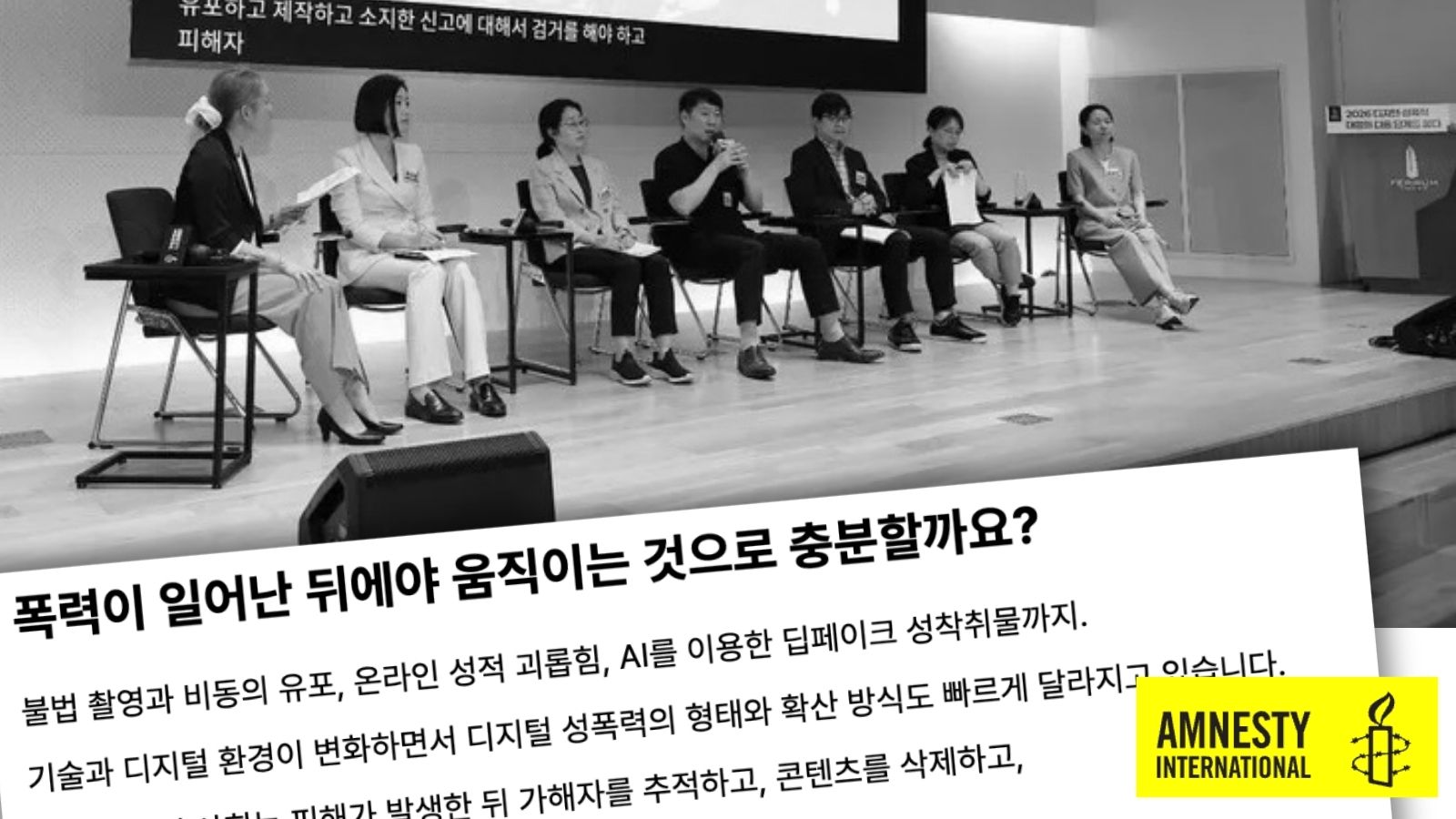
South Korean law on digital sexual violence is built around images and does not reach cases in which no image is shared, the head of the country’s specialist organisation in the field said on Thursday.
Kim Yeo-jin, who leads the Korea Cyber Sexual Violence Response Centre, said women’s reputations were being destroyed in private online groups using only their names and personal details.
“Even if photographs or videos are not distributed, the victim’s reputation can be damaged by their personal information and information implying the harm alone,” she said, according to the newspaper Women News.
She was speaking at a roundtable convened in Seoul by Amnesty International Korea, a week after the government announced its largest package of measures against digital sex crime.
Kim said Korean law regulates the making, distribution and possession of images, but that an image is only one of the kinds of digital information used against women. She pointed to what are known in Korea as acquaintance humiliation rooms — private groups, often on Telegram, in which women known to the participants are discussed and degraded. In some of them, she said, the victim’s image never appears.
South Korea reported 4,273 digital sex crime cases in 2025, up from 2,314 in 2023.
The plan
The Ministry of Gender Equality and Family, the Broadcasting and Media Communications Commission and the National Police Agency announced an integrated response plan on 20 August. It would make setting up a site that distributes illegal sexual images a principal offence, allow investigators to connect directly to such a site to gather evidence and delete what is held there, block its advertising revenue and freeze the accounts used to run it.
Kim described it as “the most advanced plan produced so far”.
She said deletion and prosecution mattered, but that victims needed to be able to recover even when material was not fully removed and no one was caught.
“Now we must think about how a victim can live when it has not been 100 per cent deleted,” she said. “The victim must be able to have the power to respond to the harm.”
The definition
Kim also questioned the legal definition the system works from. Korean law frames the offence around filming a person’s body in a way capable of arousing sexual desire or causing shame, without their consent.
She asked what such a body part is, and said the premise had to be broken — that women’s bodies are inherently arousing and that their exposure is shameful. As drafted, she said, the law treats the wrong as an offence against sexual mores rather than against a person.
Digital sexual violence should be treated as gender-based violence, she said, meaning violence premised on the idea that a woman has broken the norm that she should stay in her place.
Her recommendations were to change the legal definition, to accept reports of online gender-based violence more broadly than the current categories allow, to expand support provided by women’s organisations, and to build a gender-equal online environment through education.
Background
Unbowed reported on 18 August on a South Korean school student referred to prosecutors over an account called 지인평가 — acquaintance rating — on which photographs of female classmates were posted for strangers to rate.
The newspaper Hankook Ilbo reported from the same roundtable that four in ten requests for data in digital sex crime cases are refused, and described Korean investigators as blocked by foreign platforms.
Thursday’s session was the first of three Amnesty International Korea is holding this year. The second is to cover the human rights risks of generative artificial intelligence and the responsibility of platforms; the third is to be built around young people’s experiences. Officials from the Broadcasting and Media Communications Standards Commission, the Central Digital Sex Crime Victim Support Centre, the Seoul Metropolitan Police Agency’s cyber investigation unit and the National Assembly Research Service also took part.