
Tag: South Korea

  • Google apologises as Korea weighs criminal complaint over victim data

    Google apologises as Korea weighs criminal complaint over victim data

    Google has issued a formal apology after the personal details of South Korean women who asked it to remove illegally filmed material of themselves were published on the website of an outside research institute.

    The company said it was “deeply and heavily aware of the profound hurt and pain experienced by the victims and the public as a result of this issue”, in a statement reported by the broadcaster SBS on Wednesday.

    It said that during its internal processing, “the principle that sensitive information, as well as any specific details, must never be shared with third-party research databases was not strictly upheld”.

    Google said it had activated an emergency response with the site and permanently deleted from its servers all material relating to the notices confirmed to have been exposed. It has stopped sending the site notices of new legal deletion requests filed in Korea, and has blocked past notices relating to Korean requests from being viewed externally.

    The apology has not settled the matter. The Ministry of Gender Equality and Family is considering bringing a criminal complaint against Google over the disclosure. Officials are examining whether the company breached the Act on Special Cases Concerning the Punishment of Sexual Crimes, the Telecommunications Business Act, the Information and Communications Network Act or the Personal Information Protection Act. Any complaint would be brought by the ministry or by the Korea Women’s Human Rights Institute.

    Google had earlier told the government that the sensitive information was passed on “due to an employee’s mistake”, according to the newspaper Hankook Ilbo, which did not attribute the remark directly. Hankyoreh, which reported the disclosure on Tuesday, described the company’s initial response as a “one-line apology”.

    What was published

    Google sends deletion requests to a collaborating research institute — described by Hankook Ilbo as a private body under Harvard University in the United States — for the stated purpose of analysing and researching them.

    The requests were written by women asking for material to be taken down. One read: my sexual video has been illegally leaked and the harm is serious, please delete the search terms that identify me.

    On the institute’s website, the newspaper reported, the requests appeared alongside the women’s names, ages, workplaces, schools and mobile telephone numbers, without being de-identified.

    Some of the requests had been sent not by the women themselves but on their behalf by the ministry and by the Broadcasting and Media Communications Standards Commission.

    Both bodies wrote to the institute asking for the material to be removed, and it was taken down on 7 September. The commission carried out deletion and blocking measures on about 200 items, of which 15 were reported to have exposed information identifying individuals. Hankook Ilbo reported the ministry as understanding the problematic exposed information to number at least 200 cases.

    The remedies Google has announced apply to Korean requests. It has not said whether requests made in other countries were exposed in the same way.

    Deletion requests suspended

    The consequence for victims is that the main route to getting material removed has been closed.

    The ministry’s Central Digital Sex Crime Victim Support Centre, which files deletion requests on victims’ behalf, stopped sending them to Google in mid-August and has suspended them indefinitely. The government’s position is that it cannot resume until the risk of further disclosure is resolved.

    “Not simple human error”

    The Citizens’ Coalition for Democratic Media, a South Korean media watchdog, said Google should not be allowed to treat the matter as human error.

    In a statement published on Tuesday, it said the company should establish exactly what information had been disclosed and how much, apologise to the victims, take responsibility for any further harm caused by the re-exposure, and change the way it shares information.

    It said the government should not simply wait for Google’s answer, and should restore the victim support work quickly while investigating how personal data is handled and shared externally.

    “A victim asking for illegally filmed material to be deleted, and becoming a victim again, must end here,” it said.

    Updated on 09/09/2026 with further details of statement
  • Not only image abuse hurts women: Korean law challenged

    Not only image abuse hurts women: Korean law challenged

    South Korean law on digital sexual violence is built around images and does not reach cases in which no image is shared, the head of the country’s specialist organisation in the field said on Thursday.

    Kim Yeo-jin, who leads the Korea Cyber Sexual Violence Response Centre, said women’s reputations were being destroyed in private online groups using only their names and personal details.

    “Even if photographs or videos are not distributed, the victim’s reputation can be damaged by their personal information and information implying the harm alone,” she said, according to the newspaper Women News.

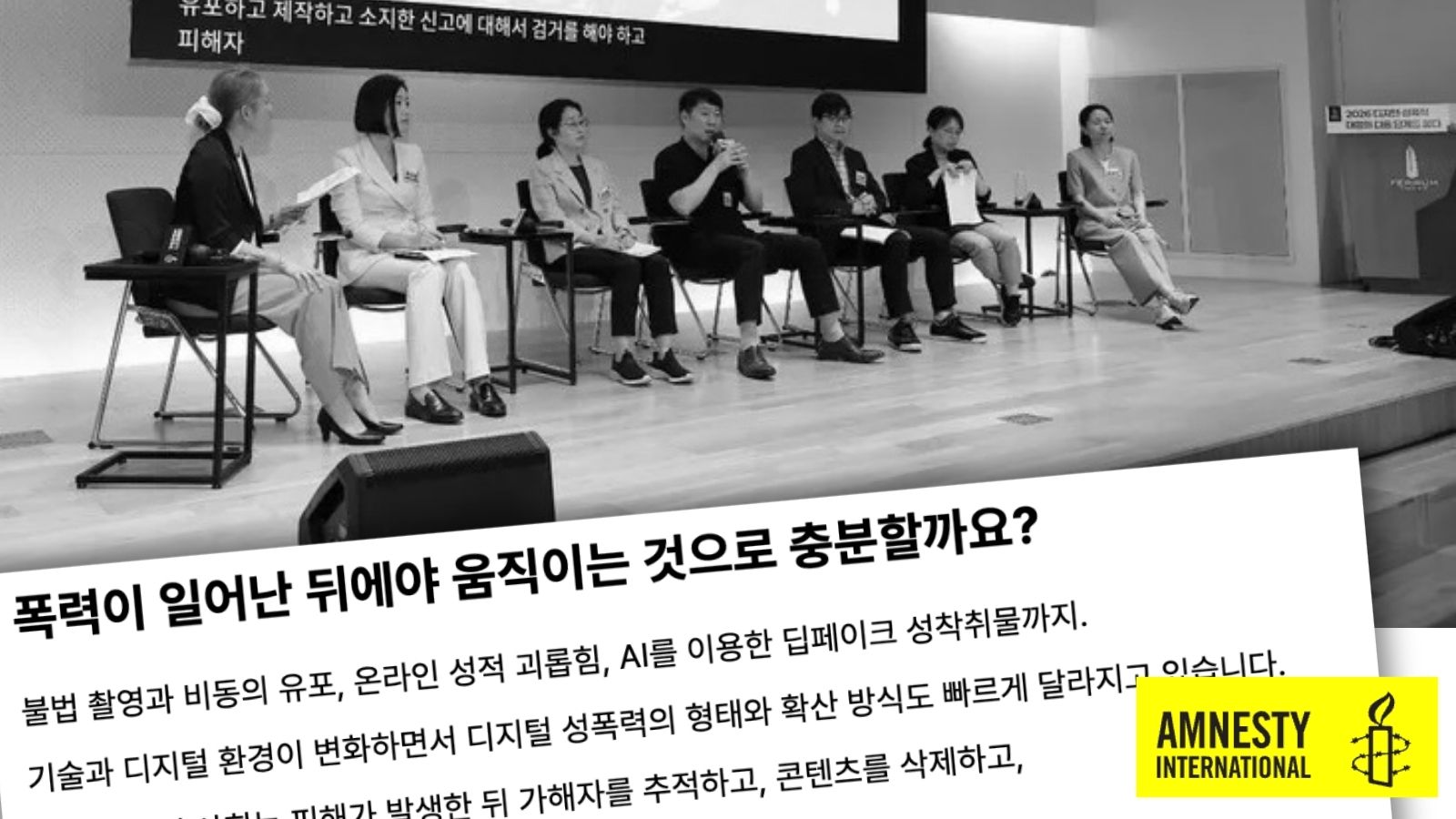
    She was speaking at a roundtable convened in Seoul by Amnesty International Korea, a week after the government announced its largest package of measures against digital sex crime.

    Kim said Korean law regulates the making, distribution and possession of images, but that an image is only one of the kinds of digital information used against women. She pointed to what are known in Korea as acquaintance humiliation rooms — private groups, often on Telegram, in which women known to the participants are discussed and degraded. In some of them, she said, the victim’s image never appears.

    South Korea reported 4,273 digital sex crime cases in 2025, up from 2,314 in 2023.

    The plan

    The Ministry of Gender Equality and Family, the Broadcasting and Media Communications Commission and the National Police Agency announced an integrated response plan on 20 August. It would make setting up a site that distributes illegal sexual images a principal offence, allow investigators to connect directly to such a site to gather evidence and delete what is held there, block its advertising revenue and freeze the accounts used to run it.

    Kim described it as “the most advanced plan produced so far”.

    She said deletion and prosecution mattered, but that victims needed to be able to recover even when material was not fully removed and no one was caught.

    “Now we must think about how a victim can live when it has not been 100 per cent deleted,” she said. “The victim must be able to have the power to respond to the harm.”

    The definition

    Kim also questioned the legal definition the system works from. Korean law frames the offence around filming a person’s body in a way capable of arousing sexual desire or causing shame, without their consent.

    She asked what such a body part is, and said the premise had to be broken — that women’s bodies are inherently arousing and that their exposure is shameful. As drafted, she said, the law treats the wrong as an offence against sexual mores rather than against a person.

    Digital sexual violence should be treated as gender-based violence, she said, meaning violence premised on the idea that a woman has broken the norm that she should stay in her place.

    Her recommendations were to change the legal definition, to accept reports of online gender-based violence more broadly than the current categories allow, to expand support provided by women’s organisations, and to build a gender-equal online environment through education.

    Background

    Unbowed reported on 18 August on a South Korean school student referred to prosecutors over an account called 지인평가 — acquaintance rating — on which photographs of female classmates were posted for strangers to rate.

    The newspaper Hankook Ilbo reported from the same roundtable that four in ten requests for data in digital sex crime cases are refused, and described Korean investigators as blocked by foreign platforms.

    Thursday’s session was the first of three Amnesty International Korea is holding this year. The second is to cover the human rights risks of generative artificial intelligence and the responsibility of platforms; the third is to be built around young people’s experiences. Officials from the Broadcasting and Media Communications Standards Commission, the Central Digital Sex Crime Victim Support Centre, the Seoul Metropolitan Police Agency’s cyber investigation unit and the National Assembly Research Service also took part.

  • South Korea moves against illegal image websites

    South Korea moves against illegal image websites

    South Korea will seek to criminalise the act of setting up a website that distributes illegal sexual images, and to give investigators the power to break into such sites to gather evidence and delete the material held on them, under a plan announced in Seoul on Thursday.

    The Ministry of Gender Equality and Family, the Broadcasting and Media Communications Commission and the National Police Agency published the “integrated response plan for illegal sites” at the Government Complex in Jongno, central Seoul. Minister Won Min-kyung presented it alongside Shin Young-gyu, director-general of the commission’s broadcasting and telecommunications user policy bureau, and Yoo Jae-sung, acting commissioner general of the police, according to Hanguk NGO Sinmun.

    The premise is that removing material has stopped working. “As long as there is a structure through which sexual exploitation material is distributed, digital sex crime repeats,” a ministry official told MBC, “so we have set the direction of neutralising the illegal sites.”

    The numbers behind it

    Digital sex crime in South Korea fell for three years and then turned. Hanguk NGO Sinmun, citing the ministry, reported 4,439 cases in 2021, 3,201 in 2022 and 2,314 in 2023, before a rise to 3,579 in 2024 and 4,273 in 2025.

    Refusals have risen alongside. The share of deletion requests from the Central Digital Sex Crime Victim Support Centre that went unmet climbed from 24.4 per cent in 2022 to 28.5 per cent in 2025, the same report said.

    Opening a site as an offence

    The Ministry of Justice intends to amend the Act on Special Cases Concerning the Punishment of Sexual Crimes so that a person who opens an illegal site can be punished as a principal rather than as an accessory.

    Hanguk NGO Sinmun reported the analogy the government is using: criminal law already punishes not only the person who gambles but the person who opens the gambling house.

    “Lawful hacking”

    The plan would introduce what the government calls an active defence system, and what Korean coverage has uniformly rendered as “lawful hacking” — investigators connecting directly to an illegal site to collect evidence and delete the original data held there.

    Hanguk NGO Sinmun reported that comparable powers operate in the United Kingdom and Australia. British police and intelligence agencies may carry out equipment interference, the remote access of computers and phones, under the Investigatory Powers Act 2016, subject to approval by both a secretary of state and a judicial commissioner. In Australia, data disruption warrants introduced in 2021 allow the federal police and the Australian Criminal Intelligence Commission to modify, add, copy or delete data in order to frustrate serious offences, and are issued by a judge or a nominated tribunal member.

    Police would also form special investigation teams of 20 officers at the Seoul, Busan, Gyeonggi Nambu and Jeonnam agencies, working on their own initiative against those running the sites rather than waiting on complaints, and would widen cooperation with foreign bodies including the FBI and the National Center for Missing and Exploited Children.

    Cutting the money

    The government intends to legislate a basis for prohibiting advertising on such sites, which Hanguk NGO Sinmun described as their main source of revenue, and to freeze accounts used to run them through the enhanced due diligence provisions of the Act on Reporting and Using Specified Financial Transaction Information.

    It also plans to work with the US Federal Trade Commission to sanction platform operators that repeatedly refuse deletion requests, and to create an emergency blocking mechanism allowing the minister to ask telecommunications carriers directly to cut access. Platform operators would be placed under a duty to delete and report child and youth sexual exploitation material when they find it.

    The domain problem

    The plan addresses directly the tactic that has defeated blocking elsewhere. Hanguk NGO Sinmun reported that sites are reopening under a new domain within one to two hours of being blocked — a practice Korean officials call domain shuttling.

    The government will fund research to detect it automatically, and build a system that blocks a new domain without a fresh review where its similarity to the blocked site is high. It also plans to develop means of blocking encrypted traffic, rather than relying on existing decryption methods.

    The wider picture

    The proposal arrives three days after the Centre for Information Resilience, a UK-based open-source investigations organisation, published findings on nudification bots that reached a similar conclusion by a different route: that the visible service is the cheapest part of the operation to replace, and that referral networks, backup domains, payment routes and upstream providers survive its removal. CIR reported bots carrying serial numbers in their names, which it read as a count of accounts already taken down and replaced.

    It is also the fourth Korean government move on this subject in ten days, following a review of the legal framework, an expert meeting on AI deepfake offences and work by the Sentencing Commission on guidelines for digital sex crimes.

  • Korean police shelved a deepfake case. The survivors filed their own.

    Korean police shelved a deepfake case. The survivors filed their own.

    A South Korean school student has been referred to prosecutors over allegations he produced sexual deepfakes of about 20 female classmates, a year after police received an allegation about the same account and closed it because they could not identify who was behind it, according to the regional publication Kyungin Ilbo.

    The cyber investigation unit of the Gyeonggi Nambu Provincial Police Agency said it had sent the case to prosecutors under the Act on Special Cases Concerning the Punishment of Sexual Crimes, in announcements reported on Tuesday by South Korean media. Police alleged the student had used photographs of girls he knew, without their consent, to make sexual images and then to post them online.

    Kyungin Ilbo said the account was called “지인평가” — acquaintance rating. On it, the paper reported, he posted photographs of girls he knew and asked others to rate their appearance, alongside deepfake material made using their photographs and video.

    The case that was closed

    Kyungin Ilbo reported that in October last year a complaint reached Hwaseong West Police Station alleging that someone was running what the publication described as a room for humiliating acquaintances. It said the station could not identify a suspect and therefore classified the case as unsolved and closed it. It said the student was subsequently identified as the suspect.

    Kyungin Ilbo said it was the survivors that got the case reopened after they filed criminal complaints early this year.

    How many

    Police estimated the number of victims at about 20, according to Kyunghyang Shinmun. Kyungin Ilbo quoted a parent as saying the number confirmed through the accused’s own lawyer was more than 30.

    The school

    Without attributing the information to a named source, Kyungin Ilbo said it understood that a school violence committee had ordered the student to transfer to another school, and that he has since applied to leave education.

    The paper quoted another parent as saying the committee met only after parents made an anonymous tip-off to the school, and that parents have had to arrange psychological support for their children themselves.

    Another parent told Kyungin Ilbo their child “is living with the anxiety that someone around them may have been involved in the crime”, and feels “considerable fear” in everyday activity — using social media, going to school.

    The school has not commented publicly, and Kyungin Ilbo does not report a response from it.

    Not unusual

    According to figures published by the National Police Agency in November 2025 and reported by the Korea Herald, teenagers are the largest group of suspects in South Korean deepfake sexual offences: about 62 per cent of those arrested for such offences were teenagers.

    The same figures, as reported by the Korea Herald, recorded 3,557 people detained for cyber sexual violence between November 2024 and October 2025, with deepfake offences the largest single category at 1,553 cases, a rise of 47.8 per cent on the previous year.

    Since October 2024, the Act on Special Cases Concerning the Punishment of Sexual Crimes has made producing such material an offence whether or not it is distributed, carrying up to seven years’ imprisonment.