
Tag: Global

  • Sexual imagery was 96 per cent of deepfake files researchers found

    Sexual imagery was 96 per cent of deepfake files researchers found

    Sexualised imagery made up 96 per cent of 3.46 million synthetic files recorded across 821 deepfake attacks worldwide in the first half of 2026, according to a report by deepfake detection company Resemble AI.

    One in six of the total attacks detected involved non-consensual intimate imagery of adults or children. But those 137 incidents produced nearly all of the material.

    An incident in its dataset is one reported event no matter the size. Resemble AI said 87 per cent of all the files it counted — about 3.01 million — came from one tool, Grok. The Center for Countering Digital Hate puts the number of sexualised images produced during the Grok episode at three million. Set against roughly 3.32 million sexualised files in total, that event accounts for about nine in ten.

    Still images predominate

    A still image appears in 90.5 per cent of the 137 incidents rather than other forms of content.

    Resemble AI says that is due to the minimal effort required. It characterises this category as impulsive and without repeat targets: the opposite of political disinformation.

    Who was targeted

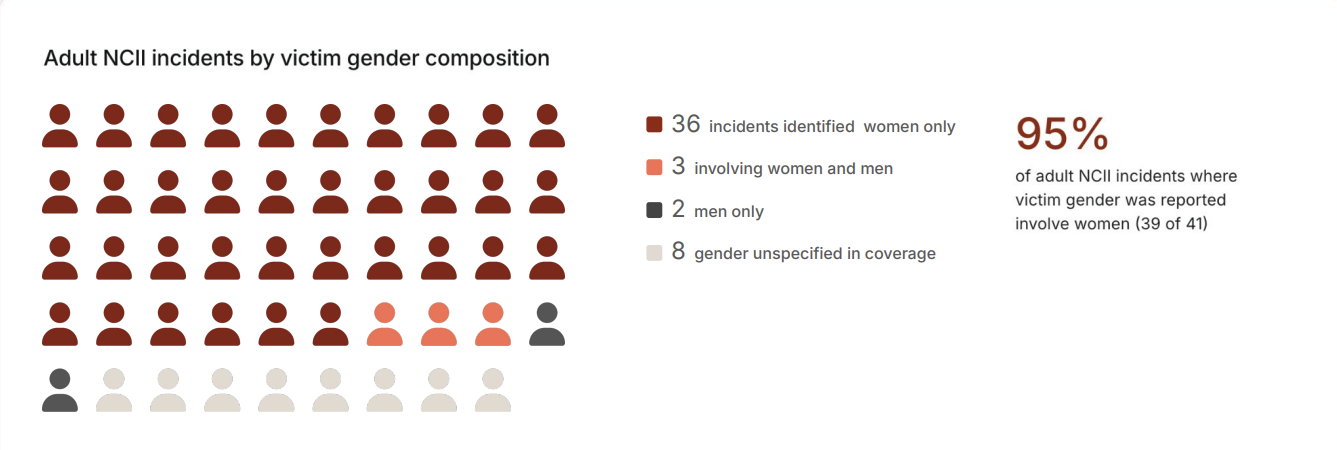
    Four in five of these attacks involved women or a mixed group when gender could be determined — 39 of 49 incidents. Thirty-six identified women only, three women and men, and two men only, with eight unspecified in the coverage. The report notes the first male victims appearing in its data, through extortion and fandom cases.
    The single largest event was down to Grok. On 29 December, X gave every user a one-click image-editing button powered by Elon Musk’s chatbot. xAI put the feature behind a paywall on 9 January and restricted “undressing” prompts on 14 January.

    Citing the Center for Countering Digital Hate, the report puts output at three million sexualised images — 190 a minute across an 11-day window, and 84 times the combined output of the five largest dedicated deepfake websites. Around 23,000 appeared to depict children: one in every 130 images, or one every 41 seconds. The New York Times separately estimated 1.8 million posts likely containing sexualised images of women.

    What the report says about its own limits

    The dataset is built from 1,760 news reports, so it counts reported attacks rather than attacks. And sexual imagery is the category most likely to surface late: 17 per cent of child sexual abuse material incidents were documented more than 90 days after the event, against 3 per cent of every other category. All four cases that took more than 250 days to surface reached the public record only through court proceedings.

    The company also calculates that the 14,915 documented victims of sexual imagery represent $2.24 billion in potential liability under the U.S. statute allowing $150,000 per victim.

  • Sexual deepfake apps on Apple’s App Store, research finds

    Sexual deepfake apps on Apple’s App Store, research finds

    Updated on Aug. 20

    Nearly 50 apps on Apple’s App Store were found to deliver sexually explicit face- and body-swapping once installed, according to research published by Copyleaks, an AI-detection company.

    Apple, responding to a request for comment from Unbowed, said only three examples were provided by Copyleaks in its article and all had been removed on July 29, two weeks before Copyleaks released its report. It had no record of Copyleaks reporting any of the apps to Apple.

    Apple said App Review Guidelines specifically prohibit overtly sexual or pornographic content, including ‘nudification’ apps and that the App Review team works round the clock to keep the App Store a safe and trusted place.

    Copyleaks’ research describes listings that disclose no sexual capability. The advertising that brings users to those listings runs on TikTok. And a number of the apps block screenshots and screen recording, which makes it harder for researchers or journalists to document what the apps actually generate, it says.

    Copyleaks says its researchers reviewed the apps over a six-month period.

    TikTok did not immediately respond to a request for comment.

    What the research describes

    Every app reviewed promoted benign features in its App Store listing, Copyleaks said, and none disclosed that it could generate sexualised imagery. Users encountered the explicit features only after downloading. The company said several user reviews came from people who had downloaded an app on the strength of its description and found the sexual content afterwards, including one reviewer who identified themselves as under 18.

    Almost all the apps operated on subscription or virtual-credit models, with sample templates viewable free and generation requiring payment. Some, Copyleaks said, may not work at all: several appeared to rely on pre-recorded or wholly synthetic material rather than processing uploaded photographs, and reviews reported apps that stopped functioning after payment.

    The finding with the widest implications concerns discovery. Virtually all the apps were found through advertisements on TikTok, Copyleaks said, and the advertisements were sexual in nature. In several cases, the company said, they explicitly promoted non-consensual use.

    “There is virtually no barrier to entry for these services anymore,” Copyleaks chief executive Alon Yamin said in the research.

    Apple said that when its App Review team identified malicious and fraudulent apps, they were analyzed in order to strengthen detection models. It noted that customers can visit https://reportaproblem.apple.com to report offensive, illegal, or abusive content, as well as scams or fraudulent activity on the App Store.

    The end of the chain

    The Independent also reported that it had found apps on Apple’s App Store offering to “strip” uploaded photographs.

    That app listed dozens of generated scenarios into which a user could place a photograph of a real person, the paper reported, including one labelled “bedroom rape”, each illustrated with graphic video.

    The app was removed after the publication flagged it to Apple, it said. Apple declined to comment directly but pointed to guidelines prohibiting overtly sexual or pornographic content, and said a number of the apps flagged to it had added violating features after being reviewed — which, if correct, describes a review process that inspects an app once and not again.

    Janaya Walker, interim director of the End Violence Against Women Coalition, told the Independent that such material allowed users to “role play violent and dehumanising acts against women” and had a “desensitising effect”, and that images created this way were “directly used to intimidate, threaten and harass women”. She called for legally binding safety-by-design requirements on platforms.

    Regulation shortfall

    The Online Safety Act reaches TikTok. By Ofcom’s account, it does not reach the App Store.

    Asked by the Independent about generative AI pornography sites and apps, an Ofcom spokesperson said the regulator was “actively assessing” their compliance with the Act and would “not hesitate” to act on failings. The spokesperson then added: “We have no powers to regulate app stores at present, but have been tasked with assessing the role they play in children encountering harmful content. We will report our findings later this year.”

    Updated on Aug. 20 at 11.09 a.m. ET with comment from Apple

  • Nudify app ads still appearing on Instagram, campaigners say

    Nudify app ads still appearing on Instagram, campaigners say

    Advertisements for artificial intelligence tools that generate sexual images of real people without their consent are still running on Instagram, the campaign group Stop Online Harm said on Wednesday.

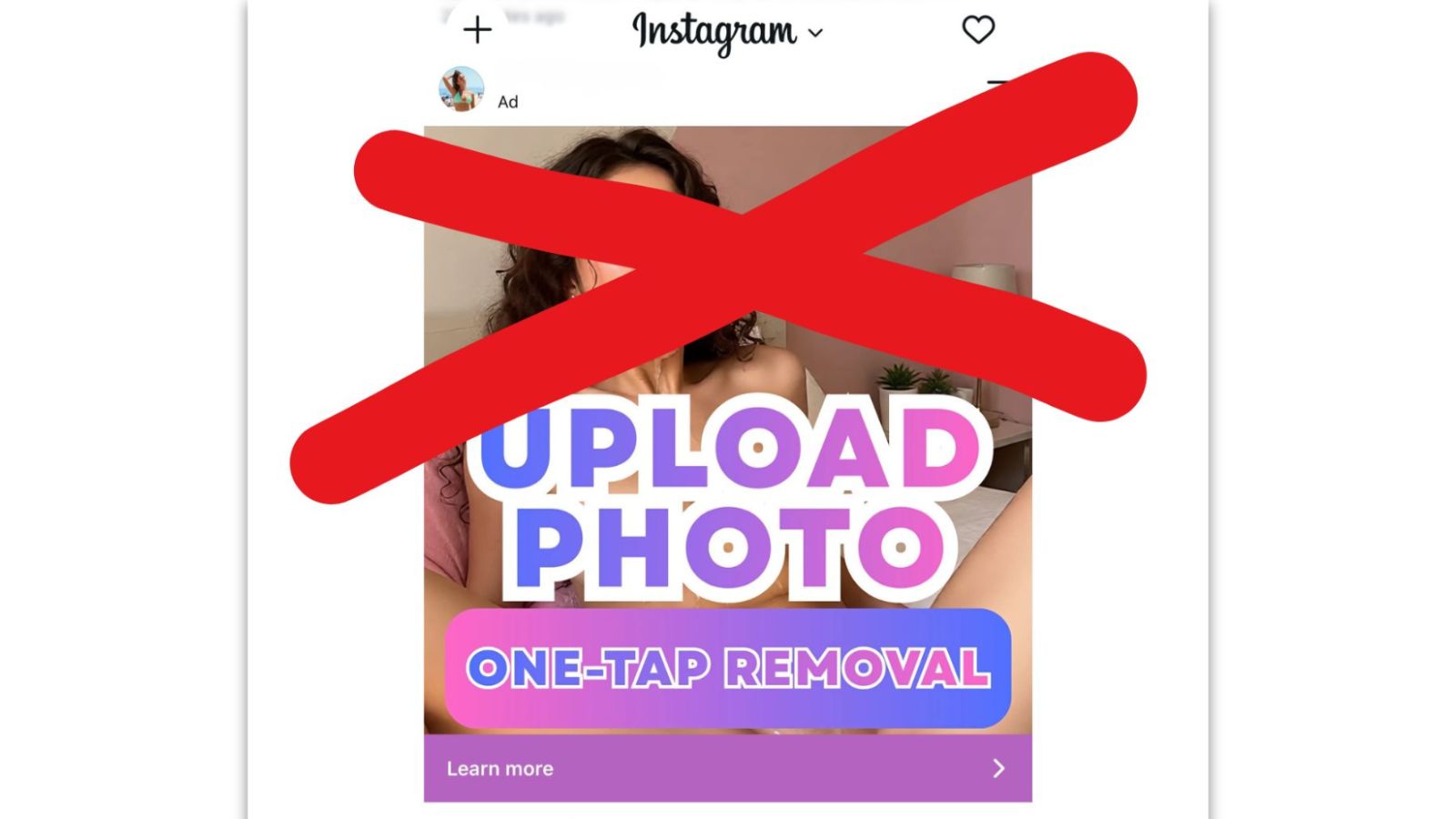
    The organisation said its team had investigated and found ads promoting tools that digitally remove clothing and produce sexually explicit images. The adverts it found offered to “undress” the subjects of photographs and showed women in sexually explicit positions, it said.

    Meta, which owns Instagram and Facebook, prohibits exactly this. Its Adult Sexual Exploitation community standard bars “promoting, threatening to share, or offering to make NCII or kissing imagery through applications or services (including AI), or instructions, even if there is no commercial or non-commercial imagery shared in the content (sometimes referred to as ‘nudify’ apps or ‘AI kissing’ apps)”. NCII stands for non-consensual intimate imagery.

    Stop Online Harm published its finding on LinkedIn.

    What has been documented

    A detailed account of nudify advertising on Meta’s platforms was published on 26 July by the Tech Transparency Project, a Washington-based non-profit that monitors large technology companies.

    Using Meta’s Ad Library — the disclosure database the company is required to maintain in the European Union under the Digital Services Act — the group traced a network of adverts to GatherOne, also trading as Hongkong Gather Wisdom, one of roughly a dozen Chinese agencies Meta authorises to place adverts on behalf of Chinese clients. Because China blocks both platforms, Chinese advertisers wanting to reach audiences abroad must in principle go through such an intermediary.

    The group identified 210 Facebook pages naming GatherOne in their advert disclosures, which between them ran about 30,800 adverts for face-swap and other AI apps. Of those pages, 43 ran more than 7,600 adverts for apps the researchers verified could nudify women. Multiple user reviews of one app flagged what appeared to be child sexual abuse material.

    Meta removed many of the adverts and disabled accounts during the investigation, the group said, but at least two dozen linked pages carried on advertising after having adverts taken down.

    Meta did not answer the Tech Transparency Project’s questions. In a statement to Bloomberg News, which reported the research, it said it takes “aggressive steps” against nudify apps and that advertisers who break its rules risk having adverts cancelled, being fined and having their accounts terminated. GatherOne told the researchers after publication that it had suspended new advertising accounts for AI nudify, face-swap and “girlfriend” services.

    Meta has not commented publicly on Stop Online Harm’s finding.

    Not the first time

    Meta sued Joy Timeline HK, the Hong Kong company behind the CrushAI nudify app, in June 2025, saying it had repeatedly evaded enforcement. Researchers had linked more than 87,000 adverts across over 135 Facebook pages to that app. A CBS News investigation separately found hundreds of nudify adverts running on Facebook and Instagram.

    Creating these images is now unlawful in a growing number of jurisdictions. Minnesota’s ban on tools that generate fake nude images took effect on 1 August after a federal judge refused xAI’s request to pause it.

    A poll published on 4 August by Women Who Tech and Rad Campaign, two organisations that campaign on the issue, found 67 per cent of American adults registered some or high concern about AI being used to create sexual imagery of women, and 71 per cent about deepfakes that sexualise children.

  • YouTube sent 1.8 million visits to nudify sites, research finds

    YouTube sent 1.8 million visits to nudify sites, research finds

    Mainstream social media platforms referred more than 5.7 million visits to websites and applications that generate non-consensual intimate images between December 2025 and March 2026, according to research published by the Institute for Strategic Dialogue.

    YouTube alone accounted for 1.82 million of those visits, more than 30 per cent of all referrals identified, the London-based research organisation found.

    The finding shifts attention from the tools themselves to the platforms that carry traffic to them. Regulatory action so far has concentrated on the applications and the app stores that distribute them. San Francisco’s city attorney wrote to Apple and Google in July over 13 named applications. Australia’s eSafety Commissioner has issued compliance directions to individual services.

    The Institute for Strategic Dialogue’s report, *Mapping the “Nudify” Tools Ecosystem*, is the outcome of a six-month project supported by the UK AI Safety Institute’s Challenge Fund. It traces how gendered deepfake content is created, circulated and sustained, and situates it within technology-facilitated gender-based violence, or TFGBV — abuse committed, assisted or amplified by digital tools and directed at people because of their gender.

    The report calls for what it describes as coordinated, system-wide responses spanning online, offline, hybrid and policy interventions, including increased platform regulation and funding for digital literacy workshops in schools.

    The research arrives as the European Union prepares to begin enforcing rules requiring AI-generated and altered content to be labelled, from 2 August. Those rules address disclosure rather than distribution, and would not on their face reach referral traffic of the kind the report describes.