

Sexualised imagery made up 96 per cent of 3.46 million synthetic files recorded across 821 deepfake attacks worldwide in the first half of 2026, according to a report by deepfake detection company Resemble AI.
One in six of the total attacks detected involved non-consensual intimate imagery of adults or children. But those 137 incidents produced nearly all of the material.
An incident in its dataset is one reported event no matter the size. Resemble AI said 87 per cent of all the files it counted — about 3.01 million — came from one tool, Grok. The Center for Countering Digital Hate puts the number of sexualised images produced during the Grok episode at three million. Set against roughly 3.32 million sexualised files in total, that event accounts for about nine in ten.
Still images predominate
A still image appears in 90.5 per cent of the 137 incidents rather than other forms of content.
Resemble AI says that is due to the minimal effort required. It characterises this category as impulsive and without repeat targets: the opposite of political disinformation.
Who was targeted
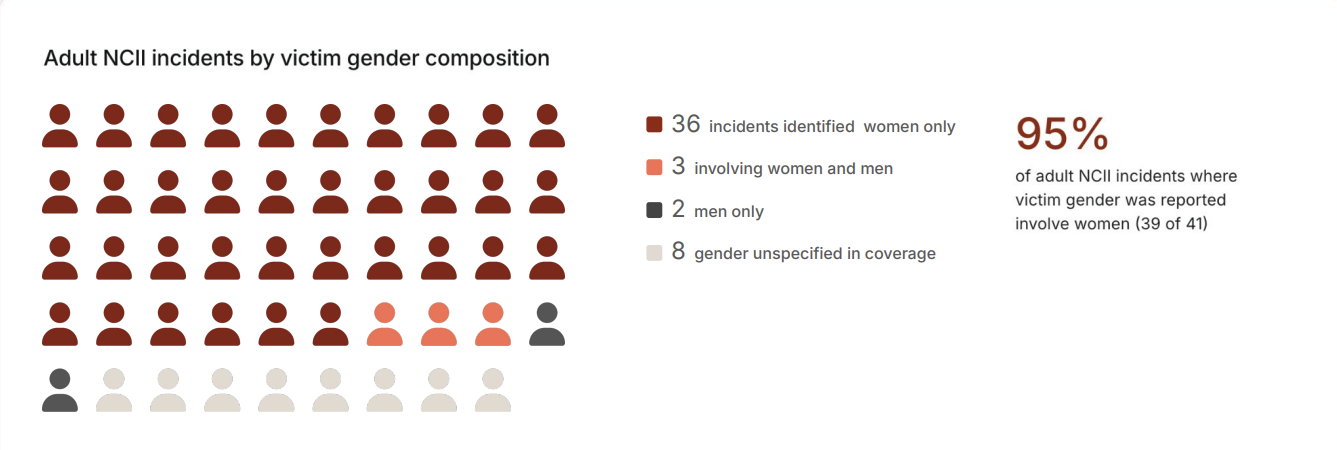
Four in five of these attacks involved women or a mixed group when gender could be determined — 39 of 49 incidents. Thirty-six identified women only, three women and men, and two men only, with eight unspecified in the coverage. The report notes the first male victims appearing in its data, through extortion and fandom cases.
The single largest event was down to Grok. On 29 December, X gave every user a one-click image-editing button powered by Elon Musk’s chatbot. xAI put the feature behind a paywall on 9 January and restricted “undressing” prompts on 14 January.
Citing the Center for Countering Digital Hate, the report puts output at three million sexualised images — 190 a minute across an 11-day window, and 84 times the combined output of the five largest dedicated deepfake websites. Around 23,000 appeared to depict children: one in every 130 images, or one every 41 seconds. The New York Times separately estimated 1.8 million posts likely containing sexualised images of women.
What the report says about its own limits
The dataset is built from 1,760 news reports, so it counts reported attacks rather than attacks. And sexual imagery is the category most likely to surface late: 17 per cent of child sexual abuse material incidents were documented more than 90 days after the event, against 3 per cent of every other category. All four cases that took more than 250 days to surface reached the public record only through court proceedings.
The company also calculates that the 14,915 documented victims of sexual imagery represent $2.24 billion in potential liability under the U.S. statute allowing $150,000 per victim.